Topsoil Calculator for Topdressing, Repairs and New Lawn Ground
Enter your project dimensions
Stand in the yard and look at what the grass is telling you. Thin turf with soil showing between the blades is one job. A bare orange patch where a trench was backfilled, or where the builder's machine turned around, is a completely different one. They sit twenty feet apart and they need quantities that are nowhere near each other, which is why a topsoil order goes wrong at the depth field rather than at the tape measure.
Half an inch over thin grass, four inches over bare clay
Two hypothetical jobs in the same yard.
Topdressing the thin lawn. Say 2,500 square feet at half an inch. That is 2,500 x 0.5 = 1,250, divided by 12 for 104 cubic feet, divided by 27 for 3.86 cubic yards. At about 2,200 lb a cubic yard, or 1.10 tons a yard, that is 4.24 tons.
Rebuilding the bare patch. Say 900 square feet at 4 inches, because seed needs real depth over compacted clay. That is 900 x 4 = 3,600, divided by 12 for 300 cubic feet, divided by 27 for 11.11 cubic yards, and 12.2 tons at the same 1.10.
The smaller area takes nearly three times the material. Depth does that, every time, so the honest half inch on the topdressing and the honest four inches on the repair are the two numbers worth arguing about before you order anything.
Working depths: a quarter to a half inch for topdressing, so the grass tips stay above it. Half an inch to an inch when you are overseeding. Four to six inches over a loosened subgrade for new seed or sod. Six inches for a flower bed, blended into what is underneath. If the ground needs to come up more than that, the lower part is fill, not topsoil.
Splitting a front lawn into shapes the tool will take
Lawns are rarely one rectangle. Break yours into pieces that do not overlap, and use Multiple areas to total up to five of them in one run.
Length and width go in as feet, and a Circle option takes a diameter for round beds and islands. Depth goes in as inches, from 0.25 up to 24, which is where a quarter-inch topdressing lives and where a deep repair still fits. Choose the material so the weight is right, then read cubic yards, tons and cubic feet off the result together. A quarter inch is entered as 0.25, and a half inch as 0.5; those decimals are worth getting right, because on a big lawn a rounding error of a quarter inch is a couple of yards.
Leave the drive, the patio and the beds out of the areas you enter. Nothing is spread on them, and on a large front lawn a patio you forgot to subtract can be most of a load.
Sold by the cubic yard, weighed at 2,200 lb
Topsoil is ordered here by volume, so the cubic yards line is the one that matches the product page. The tons line is telling you about the truck rather than the invoice: about 2,200 lb for every cubic yard when the soil is dry, and a good deal more after a wet week, because water is heavy and the yardage has not changed.
That matters on the handling rather than the ordering. A pile that has taken rain can weigh a third more to the shovel and smears instead of raking, and since the wet stretch here runs from about December into April, plan to spread within a few days of the load arriving rather than letting it sit under the weather.
Where five percent stops and the low spots start
The form carries one optional control: a tick box that adds five percent for compaction and spillage. It starts ticked, there is no automatic allowance beyond that, and nothing is added if you untick it.
Five percent is plenty on a topdressing, where you are working to a surface you can see. It is thin on a new lawn over rough ground. Spread topsoil across a subgrade that has been scarified, rutted by a machine or backfilled over a trench and it disappears into the hollows first and covers the high ground last, and the shortfall always shows up in the last fifty square feet. On that kind of job, walk the area first and measure the depth in three or four places rather than assuming the figure you meant to grade to, then round the result up to the next half yard.
Judging the load, and what goes under it
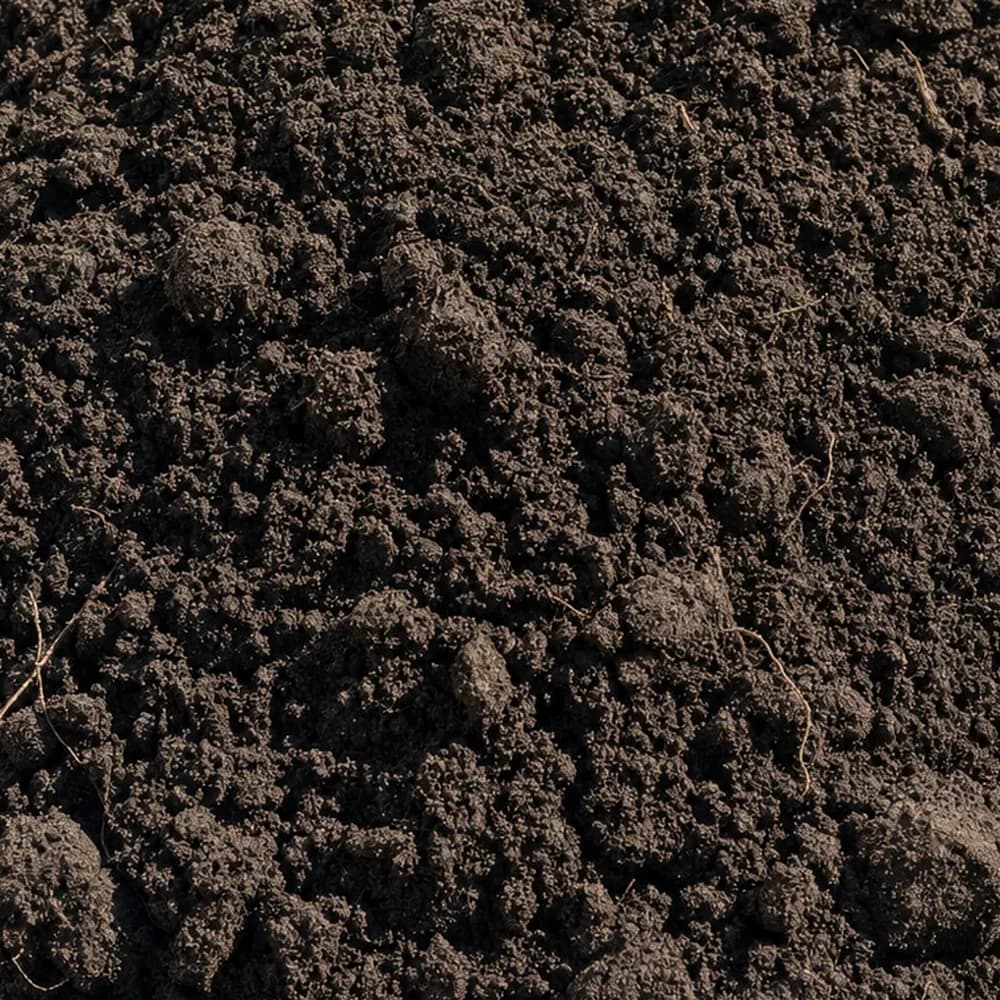
Screened topsoil has been run over a mesh to take out stones, roots and clods, which is what makes it rakeable. When it lands, take a handful. It should be dark and crumbly with an earthy smell, and a moist handful squeezed into a ball should break apart when you poke it. Soil that ribbons out between your fingers is heavy clay, soil that will not hold together at all is mostly sand, and anything gray or sour has been sitting wet.
Break the surface underneath by an inch before you spread. Four inches of good soil laid on a sealed clay pan drains like a bath with the plug in, and on ground that stays saturated through late winter that is a lawn that stays soggy for years. Keep the fall running away from the house as you finish, then firm the surface by treading it rather than stamping on it: a footprint in finished topsoil should sink about half an inch.
Two neighboring materials, so the layers land in the right order. Garden soil is the compost blend for raised beds and planting, sized on the soil calculator. Fill dirt is subsoil for bringing a grade up, and it belongs under the topsoil rather than in place of it, with the dirt calculator for that stage. Order Top Soil itself for the growing layer, pick your quantity and date there, and let the checkout work delivery out from your ZIP code.
Common questions
There is a round bed cut into the lawn. How do I size that?
Circle mode, with the width across it in feet. A bed 14 feet across at 6 inches is 0.7854 x 14 x 14 = 154 square feet, so 154 x 6 = 924, divided by 12 is 77 cubic feet, divided by 27 is 2.85 cubic yards, or 3.1 tons. Add it to the lawn with Multiple areas rather than ordering it separately.
Can I check the yardage myself?
Square feet, times depth in inches, divided by 12, gives cubic feet. Divide by 27 for cubic yards, then multiply by 1.1 for tons of topsoil. The 900 square foot repair above: 900 x 4 = 3,600, divided by 12 is 300, divided by 27 is 11.1 yards, and 12.2 tons.
Why does the tonnage change when I switch material but the yards do not?
Because you are buying a volume and the truck is carrying a weight. Screened topsoil runs about 2,200 lb a cubic yard, garden soil about 2,000 and fill dirt about 2,400, so the same lawn shows three different tons figures and one unchanging yardage. Order against the yards.
Does the tool add an allowance on its own, or do I have to tick something?
The box starts ticked, and it adds five percent unless you untick it. Treat that as cover for spillage off the wheelbarrow rather than as a margin for uneven ground. On a rough or freshly graded subgrade, add your own rounding on top of it.
How do I handle the part of the lawn that runs down the bank?
Measure the flat plan dimensions, since that is close enough for anything short of a steep face, and put the effort into holding the soil there instead. Loosen the ground so the new layer keys into it rather than sitting on a slick surface, keep the depth modest on the steep part, and get seed and a mat or straw over it straight away. A summer storm will take a fresh bare slope down the hill in one afternoon.
Related calculators
Lawn math done? Soil's on us to deliver.
Screened topsoil by the cubic yard, free delivery across Tennessee.