Soil Calculator for Raised Beds Built on Cherty Clay
Enter your project dimensions
Put a spade into most yards on the Highland Rim or around the Central Basin and it stops. Chert, then clay, then rock, sometimes within a few inches of the surface. That is the reason so many vegetable beds in this state are built up in boxes rather than dug into the ground, and it is also the reason the quantity surprises people: a bed you build is a bed you have to fill all the way. This page runs one job through from the measuring to the topping off.
Why the beds go up instead of down here
A box on top of the ground gets you a root zone you control, which is worth more than any amount of digging on cherty clay. It also means the whole depth is bought rather than improved.
Before the boxes go down, loosen the ground underneath by an inch or two, even if it is rough. Roots will follow a broken surface down and stall at a sealed one, and on clay that drains slowly through a wet winter, the last thing a bed needs is a smooth pan holding water at its base.
Deciding how deep the fill has to be
Depth does more to the order than length and width put together, so settle it before you touch the tool.
An empty raised box wants filling to its full working depth, which is usually about 12 inches for vegetables. A new in-ground bed cut into existing soil takes around 6 inches worked in. An established bed that has simply run down takes 4 to 6 inches of fresh material forked through the top rather than a whole new fill.
For a box taller than 18 inches, do not buy planting blend for the whole of it. Root systems for most crops live in the upper foot, so the bottom third can be fill dirt or coarse organic matter that breaks down in place, with 8 to 12 inches of garden soil above it. Measure that 12 inches instead of guessing at it, because a tall bed filled entirely with blend puts good material where nothing will ever root.
Adding three boxes together in one run of the tool
Switch to Multiple areas and the tool will total up to five pieces at once, which covers most back gardens in a single calculation.
Length and width go in as feet, depth in inches from 0.25 to 24, and there is a Circle option with a diameter field for round planters and half barrels. Choose the soil in the material list, because the tons line is built from that material's own weight. The tick box that adds five percent for compaction and spillage is there too, though on soil it is worth understanding what it does and does not cover.
Here is the working, as a hypothetical. Two boxes at 4 by 10 feet and one at 3 by 6, filled 11 inches deep. The areas are 40, 40 and 18, so 98 square feet. 98 x 11 = 1,078, divided by 12 gives 89.8 cubic feet, divided by 27 gives 3.33 cubic yards. Garden soil weighs about 2,000 lb a yard, or 1.00 ton a yard, so that is 3.33 tons as well, which is the one material on this site where the two numbers land on top of each other.
A 20 inch tall box, 4 by 10, split into layers: 8 inches of fill dirt at the bottom is 40 x 8 = 320, divided by 12 is 26.7 cubic feet, or 0.99 cubic yards and 1.19 tons at 1.20. The 12 inches of garden soil above it is 40 cubic feet, 1.48 cubic yards, 1.48 tons. Two runs of the tool, two lines on the order, and a bed that has good material where the roots are.
Filling in lifts, watering it down, then topping off three weeks later
Do not tip the whole load into the box in one go. Fill in lifts of six or eight inches, water each one until it stops taking it, and let it drop before the next goes in. Dry blend poured to the rim looks finished and settles two inches in two weeks.
Blended soil shrinks roughly 10 to 20 percent as the compost portion breaks down, which is a good deal more than the five percent box adds. Treat that box as cover for spillage on the wheelbarrow run and plan the settling separately: fill a little proud, keep the last few wheelbarrows back, and top the beds up once after the first heavy rain. Beds carrying hungry crops want another inch or two each spring anyway.
Garden soil in the root zone, topsoil on the lawn, fill dirt at the bottom
Three products, and the split is by what the layer has to do.
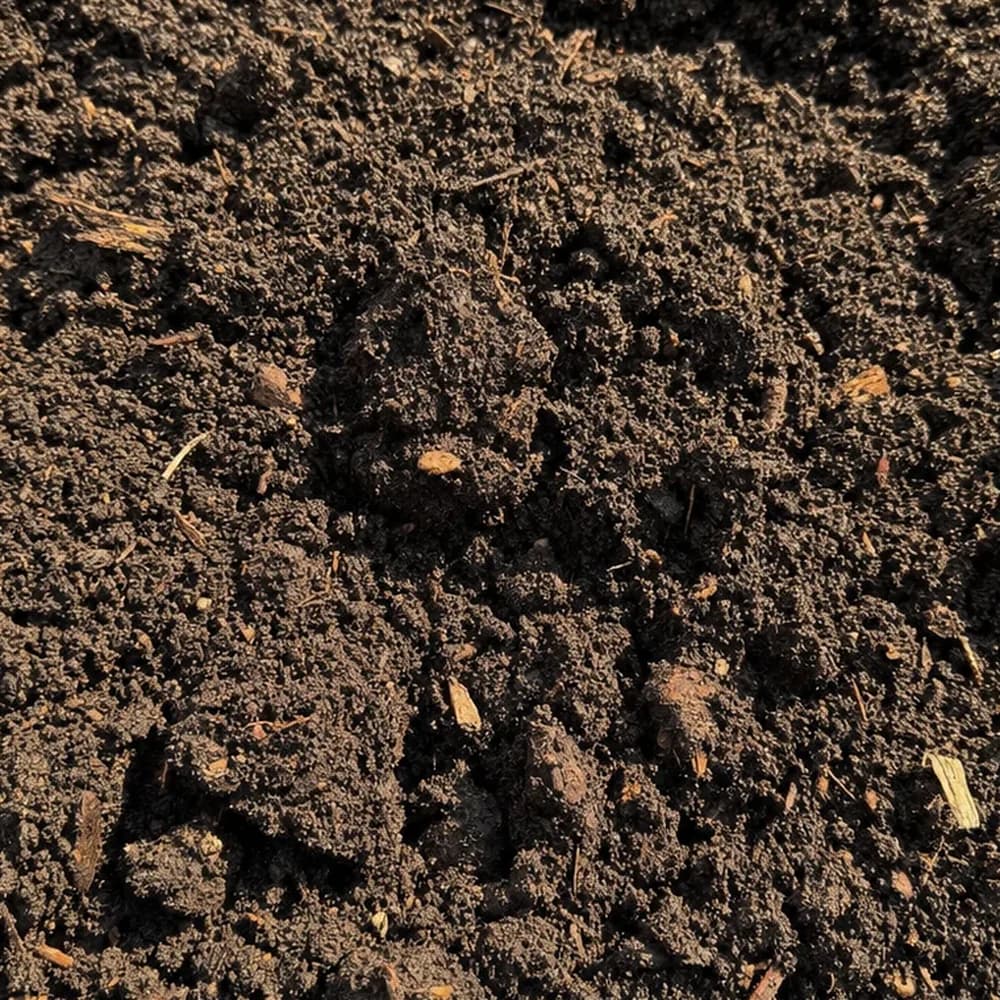
Garden soil is the blend of soil and compost that goes where plants grow: raised beds, planters, vegetable rows. Top Soil is screened natural soil for lawns and finish grading, and it is the right pick for leveling and seeding rather than for a bed, with its own topsoil calculator. Fill dirt is subsoil for raising ground and building a base, and it goes under things rather than in them; the dirt calculator handles that side.
You do not always need a full replacement. On worn native ground, forking 2 to 3 inches of garden soil through the top 6 inches gets roots established on about a third of the material, and repeating it the following season does more than gutting the whole bed ever would. Save the full rebuild for ground with construction spoil in it.
Cubic yards on the order, tons on the truck
Soil is sold here by the cubic yard, so the yards line is the one to work from. Tons is on screen because it tells you what is coming down the drive, and because the three soils are not interchangeable by weight: garden soil about 2,000 lb a yard, screened topsoil about 2,200, fill dirt about 2,400. Pick the wrong one in the list and the volume stays right while the weight goes wrong.
Ask for the pile on a tarp. Soil stains a concrete drive, and a tarp folds up and drags to the beds when you are down to the last of it. Quantity and date are set on the product page, and the checkout works delivery out from your ZIP code.
Common questions
Can I run this arithmetic myself to be sure?
Square feet, times depth in inches, divided by 12, gives cubic feet. Divide by 27 for cubic yards. A 4 by 8 box at 12 inches: 32 square feet, 32 x 12 = 384, divided by 12 is 32 cubic feet, divided by 27 is 1.19 cubic yards. Multiply by 1.0 for tons of garden soil, 1.1 for topsoil, 1.2 for fill dirt.
Garden soil and fill dirt give me different tons at the same depth. Which one is wrong?
Neither. The space you measured has not changed, only the weight of what fills it. Fill dirt is heavier because it is mineral subsoil with the organic matter screened out, and garden soil is lighter because compost is a large part of it. If you are comparing two materials, compare the cubic yards.
Is the five percent tick box enough on a bed order?
Not on its own. It is sized for spillage, and blended soil settles two to four times that as the compost works down. Use it, then add a little rounding up, and keep a wheelbarrow or two back for the top-up rather than ordering a second delivery for a few cubic feet.
The boxes step down a slope. Does the fall change the fill?
The boxes themselves are level, so enter their inside dimensions and the depth you are filling to and the slope does not come into it. What the fall does change is the frame: a box on a hillside needs its downhill side built taller so the soil sits level inside it, and that extra depth is real material. Measure the depth you will actually fill, not the height of the uphill board.
The bed by the porch turns a corner. Is that one entry or two?
Two, added in Multiple areas. Split it where the corner is so the pieces do not overlap. Say 14 by 4 and 8 by 4, which is 56 and 32 square feet, 88 in total. At 6 inches deep that is 88 x 6 = 528, divided by 12 is 44 cubic feet, divided by 27 is 1.63 cubic yards.
Related calculators
Beds measured? Soil's a click away.
Garden soil, topsoil and fill dirt by the yard, free delivery included.