Pea Gravel Calculator for Paths, Fire Pits and Play Areas
Enter your project dimensions
The order that goes wrong on this page is nearly always too deep rather than too shallow. Someone reasons that if two inches of rounded stone is good then four must be better, orders double, spreads it, and then finds that walking across it feels like walking on dry sand and that the chairs sink. Depth is the field to get right here, and on a hill lot the second thing to get right is what stops the stone leaving. Both are decided before you type anything in.
Why three inches is the ceiling on anything you walk on
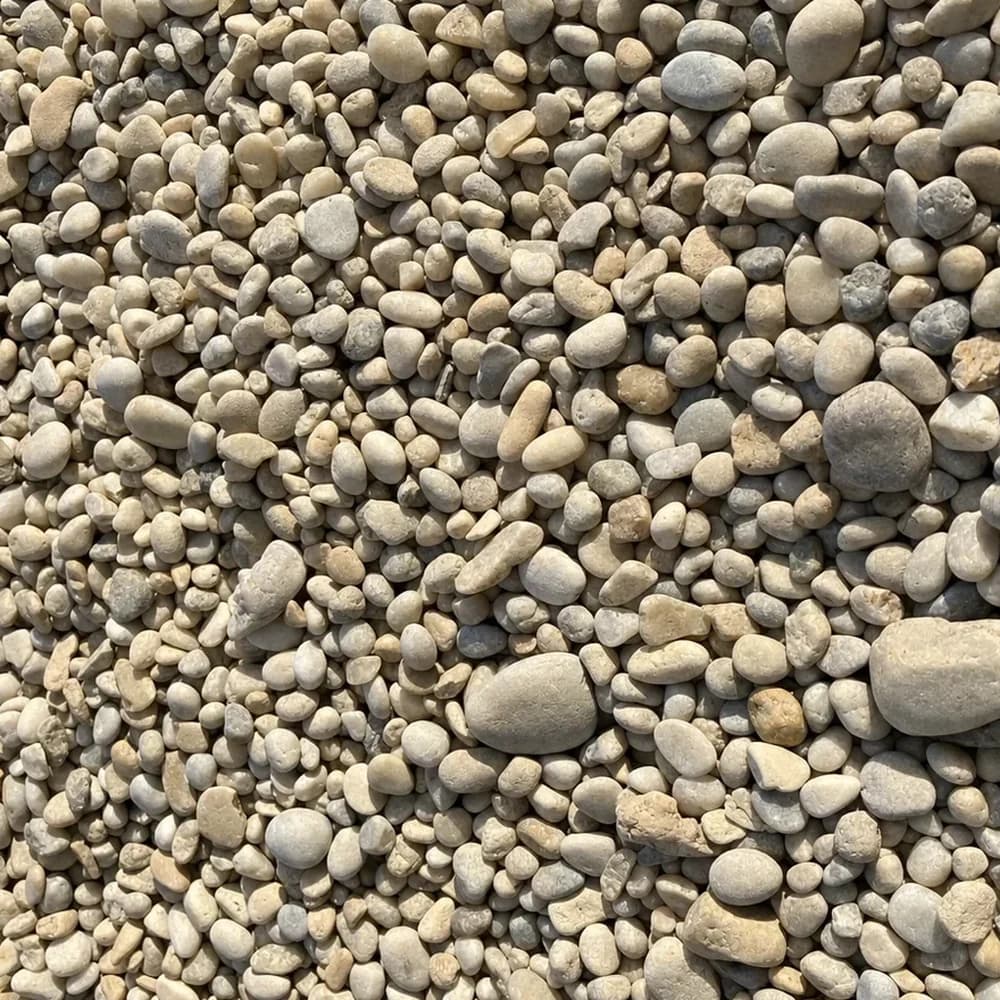
Pea gravel is rounded, screened to about 3/8 inch, and the stones do not lock into each other the way crushed material does. That is what makes it pleasant underfoot and what limits how deep it can go.
Under two inches, bare ground starts showing through the traffic line within a season. Over three, your foot sinks and keeps sinking, because there is nothing under the top layer holding it. Two to three inches is the working range for a patio, a path, a fire-pit surround or a dog run, and the only job on this page that goes outside it is a play area.
For a seating area it is worth putting two inches of compacted screenings down first and finishing with two to three inches of pea gravel on top. The firm layer underneath is what keeps a chair leg from disappearing.
How do I measure a path that wanders and a circle that does not?
Paths first. Measure along the center line rather than around the outside of a curve, and take the width in two or three places and average it. A path from the back steps to the garden gate, 26 feet along the middle and 4 feet wide, is 104 square feet. At two and a half inches: 104 x 2.5 ÷ 12 = 21.7 cubic feet, ÷ 27 = 0.80 cubic yards, x 1.4 = 1.12 tons.
Circles are cleaner, and the fire-pit surround is the job this material is best at. Say a 14-foot circle of gravel with a 4-foot fire ring in the middle of it that gets no stone. Run Circle mode twice. The full circle is 0.7854 x 14 x 14 = 153.9 square feet. The pit is 0.7854 x 4 x 4 = 12.6. Take one from the other and you have 141.3 square feet of gravel. At 3 inches: 141.3 x 3 ÷ 12 = 35.3 cubic feet, ÷ 27 = 1.31 cubic yards, x 1.4 = 1.83 tons. Order two and keep the remainder for the side everyone walks in from.
The tool also takes Multiple areas, up to five, so a path that runs into a seating circle can be totaled in one estimate.
Does a swing set really need a foot of it?
Yes, and this is where the arithmetic stops being gentle. Loose fill under play equipment is maintained at 9 to 12 inches for fall protection, and the equipment manual sets the figure rather than this page. Be clear about what you are buying, too: this is landscape pea gravel, it is not sold as certified playground surfacing, and the required depth, the fall-zone footprint and the maintained depth all come from the equipment manufacturer's instructions rather than from us.
At 12 inches, one cubic yard covers 27 square feet and one ton covers about 19. A modest 16 by 12 foot fall zone is 192 square feet: 192 x 12 ÷ 12 = 192 cubic feet, ÷ 27 = 7.11 cubic yards, x 1.4 = 9.96 tons. Ten tons, for a fall zone smaller than most decks.
| Depth | 1 cubic yard covers | 1 ton covers |
|---|---|---|
| 2 in | 162 sq ft | about 116 sq ft |
| 3 in | 108 sq ft | about 77 sq ft |
| 4 in | 81 sq ft | about 58 sq ft |
| 12 in, play area | 27 sq ft | about 19 sq ft |
Read the bottom row against the top one before you decide a play area is a weekend job.
Should a smooth 3/8 inch stone not weigh less than a crushed one?
Because the rounded shape does not leave as much air in the pile as it looks like it should. On this site's published figures a cubic yard of pea gravel is about 2,800 lb, or 1.40 tons, which is the same as #57 and 3/4 inch crushed stone.
That catches people who assume smooth, small and gentle means light. It does not, and a two-ton order is two tons on the drive whichever of the three you picked. Where the weights do move is at the ends of the range: river rock at 1 to 3 inches runs about 2,700 lb a yard, and crusher run, with its fines packed into the voids, runs about 3,000.
Is the extra five percent worth ticking for loose stone?
The box adds five percent for compaction and spillage. Pea gravel is not compacted, so the compaction half does not apply, but the spillage half does and then some. Rounded stone escapes a wheelbarrow, rolls off a shovel and finds its way into the lawn at every edge.
Tick it, and separately hold back a bucket or two from the spread. The traffic line down the middle of a path thins first, and topping it from a reserve a year later is easier than ordering a fraction of a ton.
What the tick box cannot fix is an edge that lets the whole lot walk away. Steel, aluminum, timber or paver edging, set an inch proud of the finished gravel, is what keeps the stone where you put it. Edging installed flush lets stone work over the top of it inside a season.
On a lot with fall on it, will rounded stone stay where I put it?
This is the question that matters most on the kind of lot this state is full of. Past a grade of about five percent, rain and foot traffic move rounded stone downhill and edging only slows it. Tennessee storms make that worse: a summer downpour on a sloped path will do more in an hour than a month of walking.
On any real fall, use angular crushed walkway gravel instead, which knits together and stays put, and size it with the gravel calculator. If you want to keep pea gravel on a slope, lay a honeycomb stabilizing grid under it first. For decorative beds, dry creek lines and anything being looked at rather than walked on, larger rounded stone is the better choice and has its own river rock calculator.
Plenty of yards use two or three of them: crushed stone on the sloped section of path, pea gravel around the fire pit, river rock in the bed against the foundation. Run each footprint separately and add the orders.
When the tonnage is settled, choose a quantity and a date on the 3/8" Natural Pea Gravel page. Delivery is arranged at checkout by ZIP code.
Common questions
Where should two tons of pea gravel go when it lands?
On something hard, and on a slight rise if the lot gives you one. Rounded stone spreads out under its own weight as soon as the bed lifts, so a pile on a slope keeps moving and a pile on grass leaves stones in the lawn for years. A tarp on a flat piece of drive is the easy answer, and it is worth walking the route from the tip spot to the work first, since a wheelbarrow of this material is heavier than it looks.
The result shows tons and cubic yards. Which is on the order?
Tons. Pea gravel and the other stone grades here are sold by weight, so the tons line matches the product page. Cubic yards is still worth a look, because it tells you the volume that has to go somewhere while you spread, and a cubic yard is a cube three feet each way.
Is the depth I enter the loose depth or the settled one?
The finished depth you want to walk on. Pea gravel is not rolled, so there is no compaction step to allow for. It will settle a little as it beds into whatever is underneath and rain washes the last of the dust off it, and that is already inside the range on this page rather than something to add to it.
My seating area is an oval, not a circle. What do I enter?
Measure the long way and the short way across it, average the two, and use that as the diameter. An area running 16 feet by 12 gives 14, so 0.7854 x 14 x 14 = 154 square feet. The answer is a shade high on a true oval, which is the direction you want to be wrong in on a material that spills.
How do I check the tonnage without the tool?
Square feet, times depth in inches, divided by 12, divided by 27, times 1.4. A 10 by 10 patio at 3 inches: 100 square feet, 100 x 3 ÷ 12 = 25 cubic feet, ÷ 27 = 0.93 cubic yards, x 1.4 = 1.3 tons. Most patios of that size come in under two tons.
Related calculators
Under two tons covers most patios.
3/8 inch natural pea gravel, priced by the ton, delivered free.