River Rock Calculator for Borders, Splash Zones and Dry Creek Lines
Enter your project dimensions
The choice that decides a river rock order is not how big the bed is. It is how big the stone is. Depth has to run to roughly twice the diameter of the rock or the ground shows through, so the same border takes more than twice as much material in 2 to 4 inch stone as it does in the 1 inch size. Settle that first, and then the tape measure has something to answer to.
Four ways a decorative rock order lands short or long
Most of the corrections on this page come from the same handful of habits.
- One depth for every size. Three inches is a fine layer for 1 to 3 inch rock and a thin one under 2 to 4 inch pieces. Depth belongs to the stone, not to the bed.
- Reading the tons line as though it were yards. River rock runs about 2,700 lb a cubic yard, so a delivered ton is roughly three quarters of a yard. The pile in the drive always looks smaller than the number sounded.
- Measuring the grass line instead of the bed. Fabric gets pinned out to the finished edge and the rock covers all of it. Measure where the edging will sit, not where the lawn stops today.
- Tipping rock over old mulch. The mulch underneath keeps rotting, the surface dips unevenly a year later, and the hollows fill with weed seed. Strip it off first.
Feeding it a curving border, four splash pads and a creek line
The tool takes Rectangle, Circle or Multiple areas, and it will total up to five pieces in one run, which suits a yard where the rock work happens in several separate spots.
Length, width and diameter go in as feet. Depth goes in as inches and the field accepts anything from 0.25 to 24. Pick the stone from the material list so the tonnage uses that stone's own weight, leave the box that adds five percent for compaction and spillage ticked if you want a little margin, and the result comes back as cubic yards, tons and cubic feet together. There is an email button if you would rather have the figure sent to you than copied off the screen.
Curves are easier than they look. For a border that bends around a bay window or a porch, walk the centerline for the length and take three or four widths along it, then use the average. For a shape with no straight side anywhere, split it into a rectangle and a half circle and let Multiple areas add them up.
Depth at twice the stone, and what a ton covers once you set it
| Stone | Layer depth | One ton covers about |
|---|---|---|
| 3/4 to 1 inch rock | 2 inches | 120 sq ft |
| 1 to 3 inch river rock | 3 inches | 80 sq ft |
| 2 to 4 inch large river rock | 4 to 5 inches | 53 sq ft |
Those coverage figures are the same arithmetic the tool runs, turned around. A cubic yard of river rock weighs roughly 2,700 lb, which is 1.35 tons, so one ton is about 0.74 of a yard, or 20 cubic feet. Spread 20 cubic feet three inches deep and it reaches 80 square feet. Go to five inches for the big stone and the same ton covers barely half of that.
A foundation border and a dry creek below a hill drive
Both of these are made up to show the working.
A border along the front of the house. Say 42 feet long and 3 feet out from the wall, which is 126 square feet, laid 3 inches deep in 1 to 3 inch stone. That is 126 x 3 = 378, divided by 12 for 31.5 cubic feet, divided by 27 for 1.17 cubic yards. At 1.35 tons a yard it comes to 1.58 tons, or 1.66 with the five percent ticked. Order one and three quarter tons and put the remainder along the front edge, which is the part that thins first.
A dry creek line taking runoff off a sloping drive. Say 24 feet long and averaging 4.5 feet across, so 108 square feet, at 4 inches of large river rock. That is 108 x 4 = 432, divided by 12 for 36 cubic feet, divided by 27 for 1.33 cubic yards, and 1.80 tons at the same 1.35. Call it 2 tons, because a channel that takes a summer storm off a hillside wants its low point built up rather than scraped thin.
Three stones for three jobs, and the fabric that goes with each
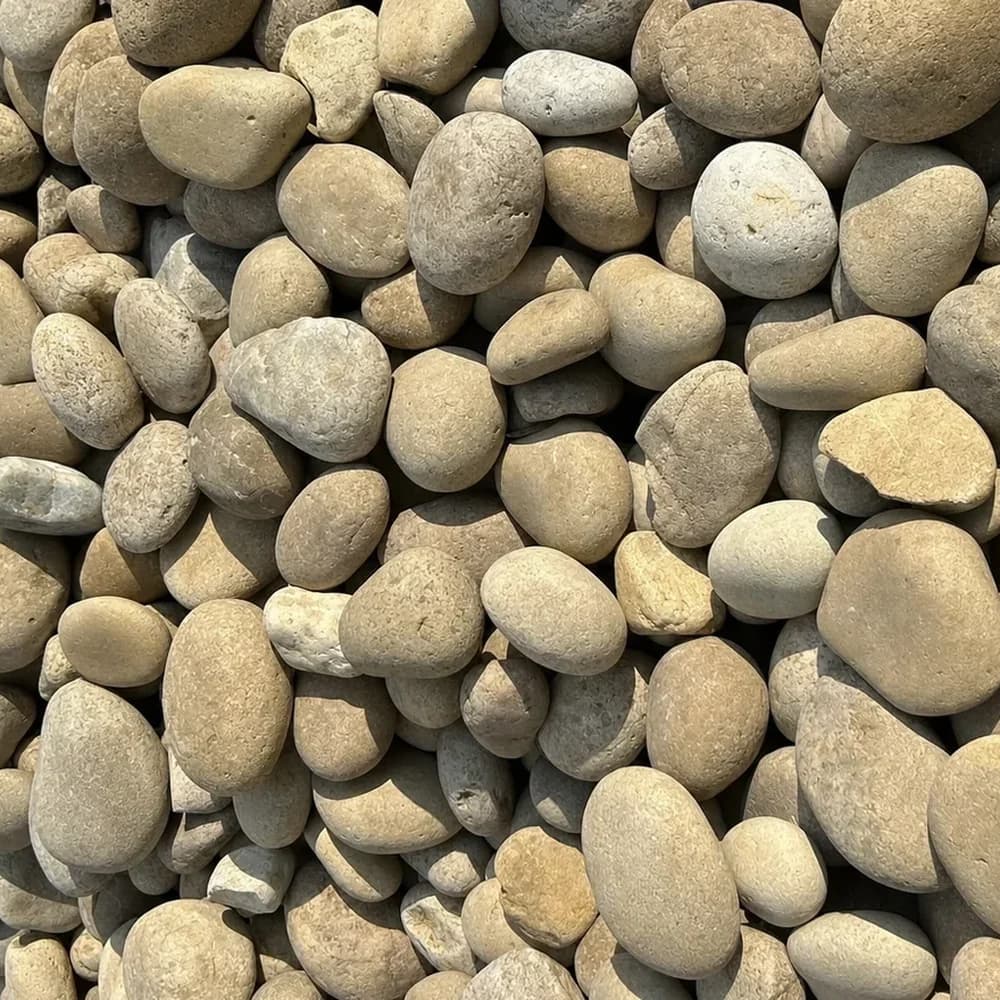
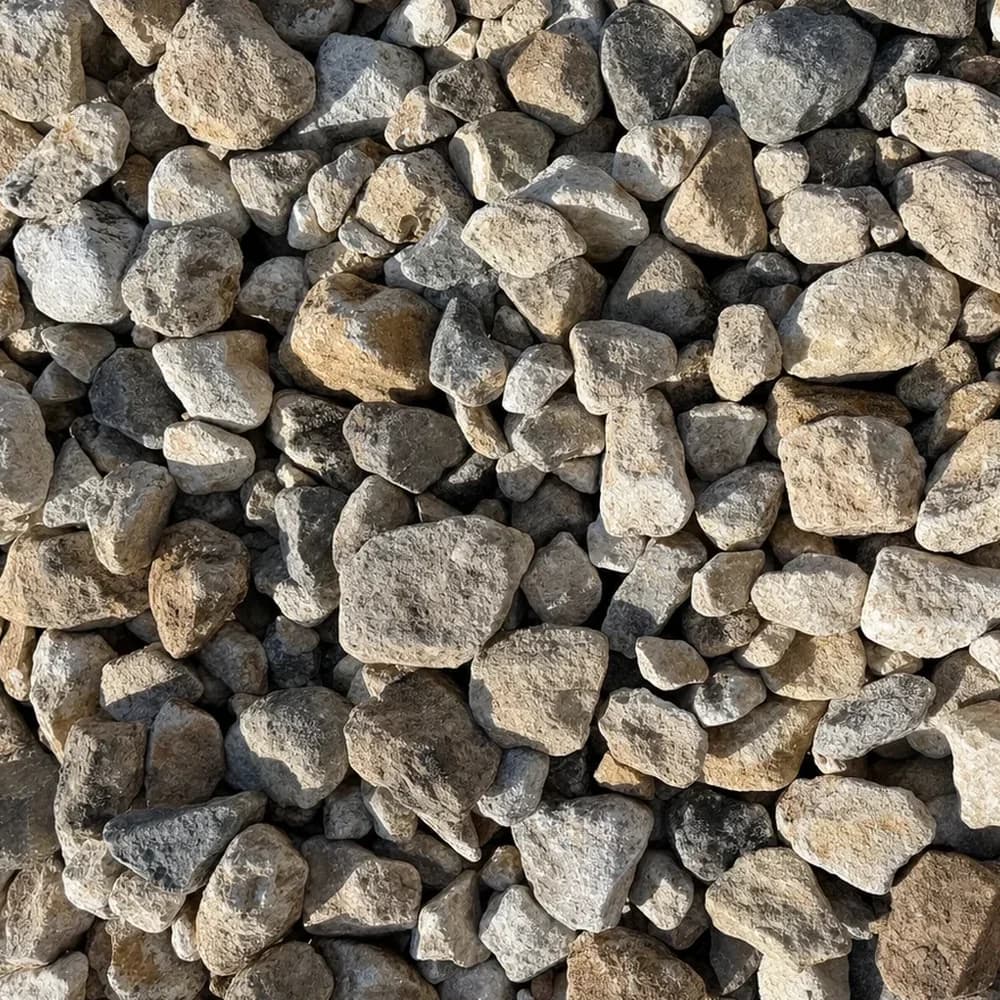
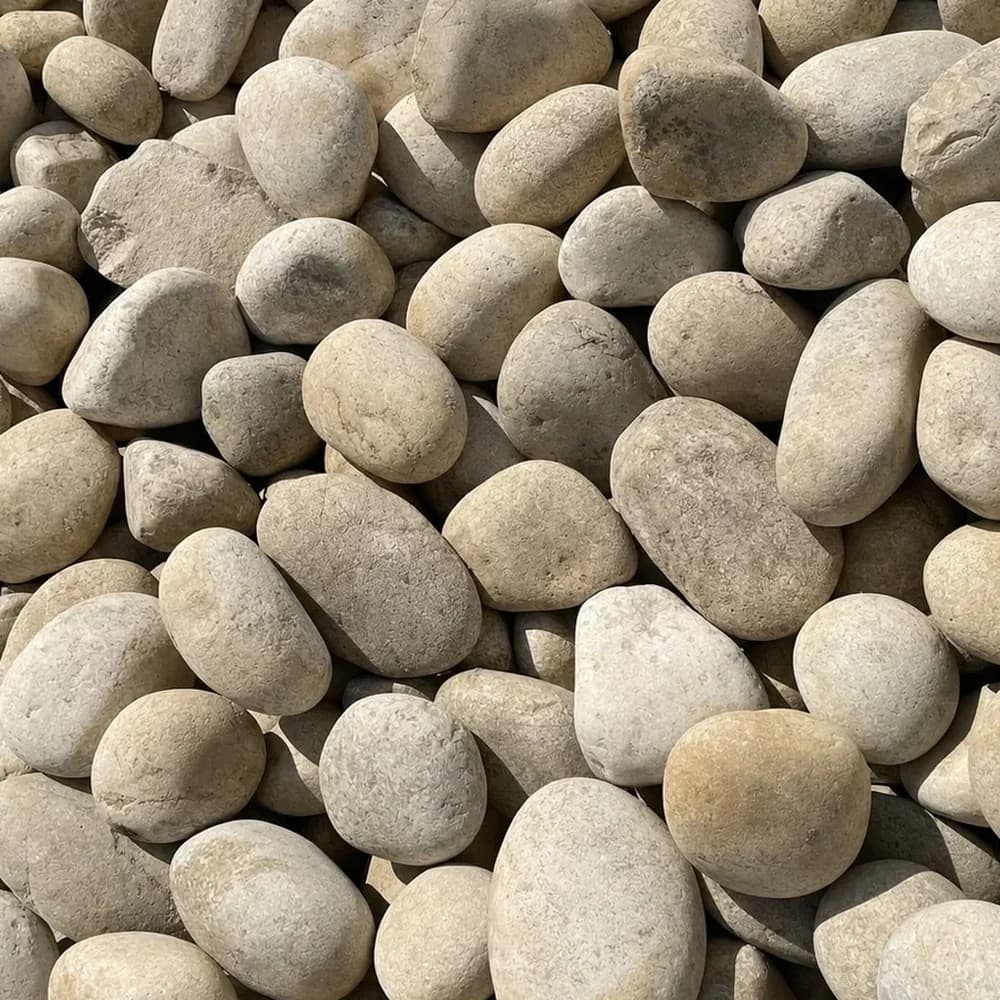
River rock at 1 to 3 inches is the ordinary bed and border size, smooth enough to look intentional and heavy enough to stay put on a gentle fall. Large river rock belongs in the middle of a dry creek and anywhere runoff picks up speed. Set the biggest pieces with about a third of each one buried, so the channel looks water-worn rather than poured out of a bucket. Drain rock is the angular option for a run that is genuinely carrying water rather than being looked at.
Fabric changes with the job. Under a decorative bed, non-woven fabric goes down first and gets pinned, or the stone works its way into the soil and weeds come up through the gaps within a few seasons. In an active drainage line, wrap the fabric around the stone instead of laying it underneath, so silt stays out of the voids. In beds that are actually planted, shredded mulch is the better surface, since rock holds summer heat against roots, and the mulch calculator sizes that in yards instead.
Hose the rock down once it is placed. Transport dust dulls the color until the first rinse, and people often decide the wrong stone turned up when what turned up was a dusty version of the right one.
When the tonnage looks right, pick a quantity and a date on the product page. Delivery is set by ZIP code during checkout, so have a firm spot chosen where the truck can back in and tip clear of the beds.
Common questions
A dished middle and an edge that feathers out. Does the tonnage still hold once the bed is raked level?
The arithmetic is exact for what you type in. The slack is all in the measuring, and in how level the ground underneath is. A bed with a dished middle takes more than its average depth suggests, and an edge that feathers out takes less. Round each measurement up to the next foot and the two tend to cancel.
Border, creek channel or a run that is carrying water. Which product page takes the order?
The one for the size you chose in the material list. Beds and borders go to River Rock, channel and anchor stone to Large River Rock, and a run that is moving water to Drain Rock. Quantity and delivery date are chosen there.
Should the driver tip the rock onto the planted bed and save the wheelbarrow work?
Better not. A tipped heap of rock crushes plants and compacts whatever it lands on, and rock does not rake out of a pile the way mulch does. Have it dropped on a firm, flat spot near the work, on a tarp if the drive matters to you, and wheelbarrow it in.
Rock is sold by the ton but a bed is a volume. Which of the two output figures do I order from?
Rock is ordered by the ton, so that is the line to work from. The yards figure is there because it is the volume you are filling, and because it is how a pile gets described on site. One is just the other multiplied by 1.35.
Is the depth box asking for the raked-level finish, or for what is left after the stone settles into the fabric?
The finished loose layer. Decorative rock is not compacted, it is raked level, so enter the depth you want to see when the job is done. What it will do over a year or two is settle a little into the fabric, which is one reason the five percent box is worth ticking on a bed you would rather not reopen.
Related calculators
Rock beds are a one-time buy.
River rock, large river rock and drain rock by the ton, free delivery included.