Crusher Run Calculator for Hill Lanes, Barn Pads and Base Courses
Enter your project dimensions
The work behind most orders off this page is a rebuild. A lane that turned to ruts through a wet February, a barn pad the tractor has pumped into the clay, a patio going in where the ground has never carried anything. Depth decides the load far more than length does on jobs like those, so the depths come first and the measuring second.
Compacted depths from a garden path to a tractor turnaround
Every figure below is the depth after rolling, not the depth of the loose material you spread. The tonnage column uses this site's published weight for crusher run, about 3,000 lb a cubic yard, or 1.50 tons.
| What is going over it | Compacted depth | Per 100 sq ft |
|---|---|---|
| Path, walk or patio base | 4 in | 1.9 tons |
| Car drive on firm ridge ground | 4 in | 1.9 tons |
| Lane taking a pickup and a trailer | 6 in | 2.8 tons |
| Barn, shed or equipment pad | 6 in | 2.8 tons |
| Turnaround a tractor or a loaded truck uses | 8 in | 3.7 tons |
| Clay that was soft when you stripped it | add 2 in | add 0.9 tons |
The last row is the one that catches people out on the Highland Rim and around the Central Basin, where cherty clay holds water for weeks after a wet spell. If the subgrade prints under your boot, the first lift disappears into it and the depth you measured is not the depth you end up with.
Entering a straight lane, a turnaround circle or a drive that bends
Pick Rectangle for a lane or a pad and give it a length and a width in feet. Pick Circle for a turnaround or a fire pit surround and give it a diameter in feet. Pick Multiple areas when a drive changes width partway along or opens out at the top, and add the pieces separately, up to five of them.
Depth goes in as inches and the field takes anything from 0.25 to 24. Choose your material, then leave the tick box that adds ten percent for compaction and spillage ticked, or untick it. There is a button that will email the figure to you once it is calculated. The result comes back three ways: cubic yards, tons and cubic feet.
Measure along the ground rather than across the level, because the stone covers the surface as it lies. On a lane that climbs, a tape laid on the surface gives you a longer number than the plan distance, and that extra length is material you will need. Depth is still taken straight down into the layer, not along the grade.
Where the fines earn their keep, and the two places they don't
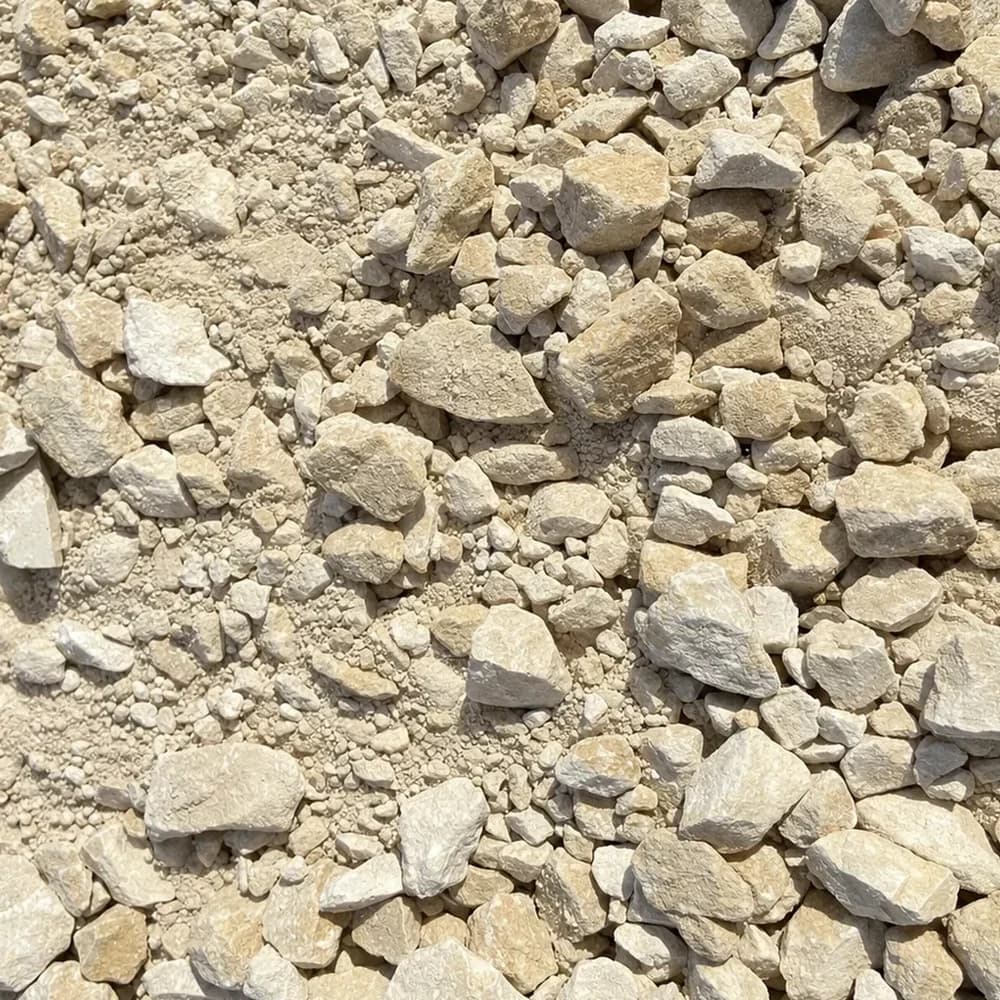
Crusher run is a three quarter inch minus blend, angular crushed stone with the stone dust left in, and everything it does well comes from those fines packing into the gaps between the larger pieces. Damp it, roll it, and the layer behaves like one piece instead of a heap of loose stone.
That same density is why it has no business in a drain. Fines hold water, and a French drain or a footing line wants clean washed stone with open gaps: size that job with the stone calculator instead.
It also is not the finish layer on a drive that sees regular traffic. Build the base here, then size the wearing course of driveway gravel or #57 stone separately with the gravel calculator. On a quiet country lane you can leave crusher run as the running surface, at the cost of dust through a dry August and a reshape every few years.
Two neighboring tools are worth naming so you land on the right one. Dense Grade Base is a different product on this site: one inch minus, a larger top size for heavier graded work under lots and slabs, and it has its own road base calculator. It is not a second crusher run. And if pavers are going over the top, use the paver base calculator, which adds the six inches of base that sit outside the finished edge and the dig-out above it.
A 120-foot lane and a 30-foot turnaround, worked through
Both are made up, and both use the arithmetic the tool runs: length times width, times depth in inches divided by 12, divided by 27, times 1.50.
The lane. 120 feet long, 10 feet wide, 6 inches compacted. That is 1,200 square feet. 1,200 x 6 ÷ 12 = 600 cubic feet. 600 ÷ 27 = 22.22 cubic yards. 22.22 x 1.50 = 33.3 tons. With the ten percent box ticked it reads 36.6. Order 37.
The turnaround at the top of it. A 30-foot circle, same 6 inches. Area is 0.7854 x 30 x 30 = 706.9 square feet. 706.9 x 6 ÷ 12 = 353.4 cubic feet. 353.4 ÷ 27 = 13.09 cubic yards. 13.09 x 1.50 = 19.6 tons, or 21.6 with the extra ticked.
Run them as one Multiple areas estimate and you get roughly 53 tons for the pair, which is the number worth having before you start splitting the work over two weekends.
Why a yard of this weighs more than a yard of clean stone
At 1.50 tons a cubic yard, crusher run is the heaviest of the common drive materials on this site. Clean crushed sizes such as #57 and 3/4 inch run about 2,800 lb, or 1.40 tons, because the gaps between the stones stay open. Screenings sit at about 2,900 lb, or 1.45.
Take the 1,200 square foot lane above at the same 6 inches. In crusher run it is 33.3 tons. The identical space in #57 is 22.22 x 1.40 = 31.1 tons. Same volume, two tons apart, which is worth knowing when you are comparing two orders that look alike on paper.
The margin soft clay swallows
Loose crusher run tightens by something like a tenth to a seventh of its depth under a roller, which is why the table above is written in compacted inches. Spread four loose inches and you finish nearer three and a half.
The ten percent option covers spillage and the material that ends up outside the edge of the run. It does not cover a subgrade that is still wet. On clay that was saturated when you stripped it, the honest move is to add the two inches from the table rather than to lean on the tick box.
Work in lifts of two to three inches, mist each one, and roll it before the next goes down. Build the fall into the compacted surface as you go, because anything you shape into the base carries through to the top.
Once the tonnage settles, pick a quantity and a date on the crusher run product page. Delivery is set at checkout by ZIP code, and the truck needs a firm spot with room to tip, which on a hill lot is usually the flattest ground near the work rather than the closest. Check the access notes before you book, and have the compactor lined up for the same week, since a pile left loose through a rain event has to be worked twice.
Common questions
The estimate gives me yards and tons. Which one do I put on the order?
Tons. Crusher run and the other stone grades here are sold by weight, so the tons line is the one that matches the product page. The cubic yards figure is useful for a different reason: it tells you how much volume has to go somewhere on your drive when the truck tips, and a yard is a cube three feet each way.
Do I enter the depth I spread or the depth I end up with?
The finished, rolled depth. The table on this page and the specs a county inspector works from are all written in compacted inches. If you enter the loose depth you spread, you have measured the same layer twice and will be short once the roller has been over it.
My turnaround is round and the pit in the middle of it is not getting stone. How do I handle that?
Run the circle mode twice. Enter the outer diameter for the first figure, then enter the diameter of the bare patch and take the second result off the first. A 20-foot circle with a 5-foot pit left out comes to 0.7854 x 400 = 314 square feet less 0.7854 x 25 = 20, so 294 square feet of stone.
Can I check the number the tool gives me without a calculator handy?
Yes, and it is worth doing once. Square feet times depth in inches, divided by 12, gives cubic feet. Divide by 27 for cubic yards. Multiply by 1.5 for tons of crusher run. A 40 by 12 pad at 4 inches: 480 square feet, 480 x 4 ÷ 12 = 160 cubic feet, ÷ 27 = 5.93 yards, x 1.5 = 8.9 tons.
I priced the same pad in three materials and the tonnages all differed. Which is wrong?
None of them. The volume is identical and the weight per yard is not. On this site's figures, a yard of crusher run is about 3,000 lb, a yard of screenings about 2,900, and a yard of pea gravel about 2,800. The heavier the material, the more tons the same hole takes, which is why the material select changes the answer.
Related calculators
Base tonnage sorted? Good.
Crusher run by the ton, the cheapest structure on the yard, delivered free.